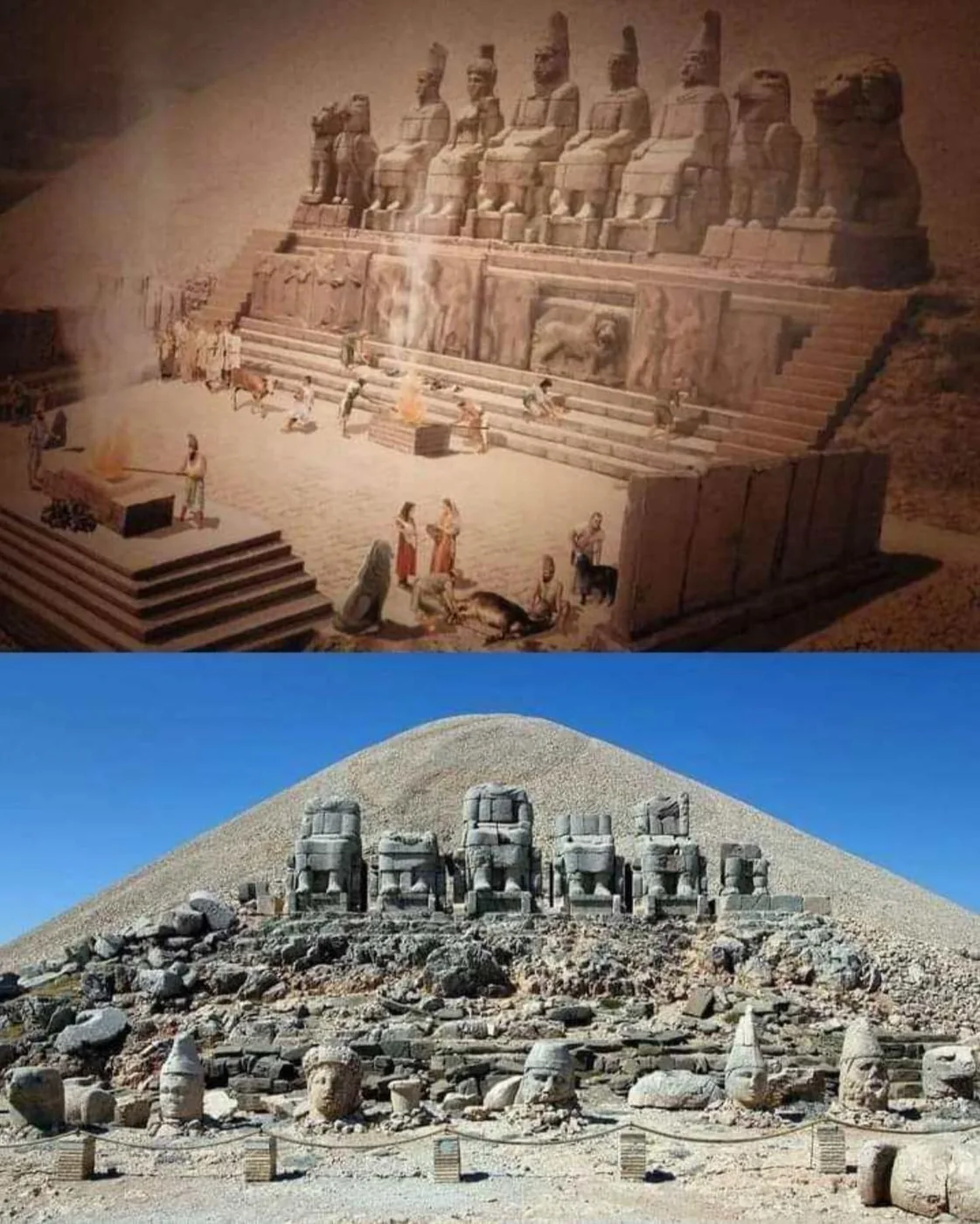
The tomb of Antiochus I on Mount Nemrut
Above is a reconstruction of the complex: giant statues seated on thrones on a stepped platform, with altars and people in front. Below is its present state: the remains of the statues in front of a pointed mound, and stone heads placed on the ground.
Mount Nemrut lies in the south-east of present-day Turkey, near the city of Adıyaman, and is more than 2100 metres high. On its summit are the ruins of a temple built in the time of the Kingdom of Commagene. That kingdom was founded by the Armenian Yervanduni (Orontid) dynasty and lasted about 2 centuries, until it was annexed to the Roman Empire in 72 AD.
Its best-known ruler was Antiochus I, who saw himself as the heir of Armenian-Iranian dynasties and a descendant of Alexander the Great, and later proclaimed himself the supreme deity of a new religion he had created. On his orders his future tomb was built on the summit, with seated statues of Zeus, Apollo, Heracles and Antiochus himself, and sculptures of animals. Earthquakes and changes of power destroyed the temple; only fragments of the statues remain, and the better-preserved heads were set on stone bases. The king’s burial has not been found to this day, but he was most likely buried right here.